The Premier Cannabis, Comedy & Stoner Philosophy Podcast
Category Archives: Stoner Philosophy
Deep thoughts for the high-functioning. No self-help fluff, just real talk on mental health and surviving adulthood with Justin Barone.Stoner Philosophy
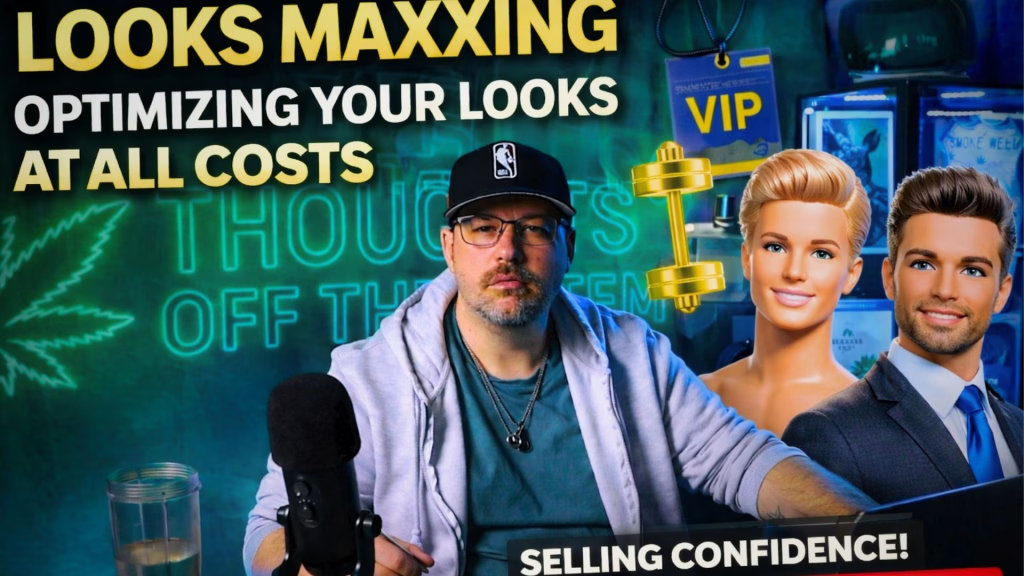
Looksmaxxing and incel culture have produced some truly unhinged ideas over the years — but hitting yourself in the face with a hammer to get dates might be the one that finally broke me. There are grown men doing this. On purpose. With an actual hammer. And they have hundreds of thousands of followers cheering them on.
I’ll let that sink in for a second.
Welcome to the world of looksmaxxing — the incel community’s full-send obsession with optimizing your physical appearance at all costs. And I mean ALL costs. We’re talking steroids at 14, crystal meth to hollow your cheeks, and a daily hammer session to your jaw because apparently that’s a thing people do now.
I’m Justin Barone. I’m 44 years old, I’m 260 lbs, and I used to be fit back in my 30s when I was about 185. Somewhere between Doritos and laziness I became what these kids would probably classify as some kind of ogre. But you know what? I still figured out that personality is the move. These kids apparently haven’t gotten that memo yet.
Let’s get into it.
What Is Looksmaxxing and Incel Culture?
Looksmaxxing is the practice of maximizing your physical attractiveness — and it started in incel culture. Incel, if you don’t know, stands for involuntarily celibate. These are dudes who can’t get a date and have decided that the reason is entirely their bone structure.
Looksmaxxing and incel culture are more connected than most people realize — the whole movement was born on incel message boards before it jumped to TikTok.
The movement got a massive boost from a 19-year-old content creator named Clavicular — and yes, that’s his actual name, or at least his online name. Braden. His name is Braden. I don’t know what we expected.
At 14 years old this kid started taking testosterone, using steroids, and by his own admission on camera — meth. Why meth? Because he thought it was basically just street Adderall. One derivative away, he says. He also took a hammer to his face every single day.
Not to bits and pieces. Just until it got red and puffy. Because he believed it would create micro fractures in his jaw that would heal into a sharper, more square jawline.
You know what else gives you a sharper jawline? Puberty. Which he was going through at the time. But he couldn’t wait.
This guy is now 19, has hundreds of thousands of followers, and allegedly earns over $100,000 a month teaching other young men how to do what he did. And somehow we as a society have decided this is acceptable.
I take partial blame. Not personally. But as a generation? Yeah. We dropped the ball.
Where Did We Go Wrong?
The looksmaxxing community and incel culture didn’t create these insecurities in young men — but it weaponized them.
When I was a teenager and I wasn’t getting invited to parties — and I wasn’t always, I was a chunky kid with a belly from eating too many Doritos — I didn’t smash my face with a hammer. Instead I went outside. Mingling with actual humans and correcting my personality in real time through real interaction was how you figured things out back then.
These kids don’t have to do that anymore. They can find a corner of the internet that validates whatever insane thing they’re thinking, and that corner will attach itself to them and grow. Before you know it you’ve got a 19-year-old doing meth for his skincare routine and an audience of young boys watching him do it.
I asked my kids about looksmaxxing. You know what they did? They rolled their eyes. Both of them. “Can you believe it, dad?” No. No I cannot. But I went deep on this one so you don’t have to.
The Weed Facts: Does Cannabis Actually Affect How You Look?
Since we’re talking about looks this week I figured we’d pivot to something actually relevant — what does weed do to your skin? Because if you’re going to take a hammer to your face you should probably know what your edibles are doing to your collagen first.
This segment’s facts come from Cosmopolitan, who spoke with dermatologist Dr. Karan Lal, MD. Here’s the breakdown:
Factor
What Cannabis Does
The Verdict
Testosterone & Acne
THC may slightly increase testosterone, which spikes oil production
Could cause breakouts in some people
Appetite & Glycemic Index
Munchies + carbs = higher glycemic index
Associated with increased acne
Anti-inflammatory Effects
THC is anti-inflammatory, may calm inflammatory pimples
Could actually help some skin issues
Stress & Cortisol
Weed can reduce anxiety, lowering cortisol
Less stress = less oil = less acne
Skin Picking
THC may reduce itch and irritation
Could help chronic skin pickers relax
Edibles & Sugar
Gummies contain sugar that causes glycation — stiffening collagen and elastin
Could contribute to sagging and wrinkles
Smoking & Skin
Smoke sits on your skin and can irritate it
External irritant regardless of strain
Dirty Equipment
Unwashed pipes and bongs spread bacteria
Can cause acne around your mouth
The honest takeaway? It’s not really the weed. It’s what you put in your body and how you take care of yourself. Clean your bong. Watch the sugar in your gummies. Manage your stress. That’s basically your cannabis skincare routine right there.
Oh, and I’ll say this — I’ve been smoking pretty regularly for years and I still get the occasional pimple along my hat line. I think it has more to do with cleaning your skin than anything else.
Dude For Real: The Looksmaxxing Terminology You Need to Know
This stuff comes straight from the looksmaxxing community and I genuinely couldn’t believe some of these are real terms that people use with a straight face. This week’s Dude For Real comes from Buzzfeed’s looksmaxxing explainer and dude — for real.
Term
What It Means
Mogging
Displaying physical superiority over someone nearby
Softmaxxing
Improving looks through skincare, diet, exercise, grooming
Hardmaxxing
Extreme methods — surgery, steroids, bone smashing
Bone Smashing
Hitting your face with a hammer to create micro fractures that reshape your jaw
Ascending
Significantly improving your physical attractiveness. The looksmaxxing version of a glow up
Mewing
Resting your tongue on the roof of your mouth to sharpen your jawline
The PSL Scale
A scoring system for facial attractiveness based on harmony, symmetry, and sexual dimorphism
Chad / Stacey
Highly attractive man or woman. Top of the PSL scale
Subhuman
The lowest PSL score. The most unattractive. Literally called subhuman
Sub 5
Anyone ranking below a 5 on the PSL scale — considered unattractive
Lookism
The belief that your value and place in the world are determined entirely by your looks
Gesture Maxxing
Using humor to attract women rather than appearance
Femoid / Foid
A dehumanizing term for women. Short for female humanoid
Hunter Eyes
Almond-shaped, deep-set eyes with low brows — considered highly attractive
The system literally calls people subhuman based on their face. That’s not self improvement. That’s a cult with better lighting.
Looksmaxxing, Incel Culture and Why Personality Is the Real Move
If you’re not getting invited to parties — and I say this with love — it’s probably not your jawline. It’s probably your personality.
You can change everything about how you look. Get the surgery. Smash your face. Chew the gum. But when the mask comes off — and it always does — if your personality is garbage, people are going to figure that out. As a result they’re going to walk away every single time.
I’ve seen the ugliest people with the most friends because most people genuinely do not care what you look like. Instead they care whether you’re fun to be around, whether you make them laugh, and whether you’re loyal. That’s it. That’s the whole list.
Be that person. That’s the move. Not the hammer.
That’s the real problem with looksmaxxing and incel culture — it sells young men the idea that their value is their face, and there’s nothing they can do about it except suffer or smash.
As for Clavicular — I watched a bunch of his content researching this episode. He’s shallow, uninformed, and has a massive platform teaching young boys that their value is their face. That’s a failure. And it’s on us as the older generation to push back on that wherever we can.
If your kid is watching this stuff, talk to them. Ask questions and be present. Because we can’t leave them to figure this out on the internet.
Use a hammer if you want.
Those are my thoughts off the stem.
🎙 Listen to the Full Episode
This week’s full seshisode — Looks Maxxing: Guys Who Smash Their Face With Hammers to Get Dates — is live now.
We go deeper on Clavicular, the full Dude For Real terminology breakdown, and the complete weed facts science on cannabis and your skin.
New episodes drop every Friday at 4:20PM. So subscribe now so the sesh comes straight to you — because we’re pushing to 1,000 followers on Spotify and every single follow counts.
From The Manosphere to Marijuana: Comparing Tactics and Ideologies
From the Manosphere to Marijuana, what do a 1930s paper tycoon, the DuPont family, the first commissioner of the Federal Bureau of Narcotics and a modern-day “Alpha” influencer have in common? They are all fueled by the same thing: A massive, fragile ego, an overabundance of pride, and a scorned inner child who runs the show. In our latest Seshisode of Thoughts Off The Stem, we’re exploring the link between the Manosphere and Marijuana. We’re talking about Louis Theroux’s Inside the Manosphere documentary and connecting the dots to the “Great Hemp Wars” of 1937. It turns out, the history of cannabis prohibition and the rise of the “Taint”—sorry, the Tate brothers—are fueled by the exact same playbook: fear, gaslighting, and overcompensation.
The People
tHEIR BACKGROUND
William Randolph Hearst
was an American newspaper publisher and politician who developed the nation’s largest newspaper chain and media company, Hearst Communications.
The DuPonts
Du Ponts have been one of the country’s richest families since the mid-19th century, when they founded their fortune in the gunpowder business. In the late 19th and early 20th centuries, they expanded their wealth through the chemical industry and the automotive industry
Inside The Manosphere: Ultra Masculine and Ultra Fragile
I recently watched the Louis Theroux doc, and like everyone else, I’m familiar with the ultra-masculine “women are only here to serve men” schtick. But honestly, It’s exhausting. These dudes are basically frat bros in the wild, uttering the stupidest collection of words I’ve ever heard while contradicting their own ideologies.
Take HSTikkyTokky—a name that sounds like a five-year-old’s favorite toy. Seriously it sounds like something that lights up and play sounds when you push it’s keys. Definitely not very masculine if you ask me. He preaches “masculinity” and says he doesn’t hate anyone, yet his content is a factory for hate speech and chaos. It’s all for the stream, all for the money. Young men following this movement need to wake up and see the parallel between the Manosphere and Marijuana prohibition: both rely on selling a false “authority” based on fear.
New Age Street-Corner Prophets: How the Manosphere Sells Insecurity
Their logic claims women are “born with value” (purely physical), while men must “create value” through financial wealth, supercar collections and a haram of women if they want. If you think a woman’s value is limited to anatomy, and men have no value, you’re a lunatic. Character is what gives us value. It’s what separates men, from boys, women, from girls and good people from losers.
When Andrew Tate brags about throwing a fight to bet on himself and triple his money, he isn’t being “manly”—he’s being a snake. These guys are nothing more than street-corner prophets in shiny suits, funding their lifestyles through the pockets of easily manipulated young men. Let’s call the Tate brothers what they are: The Taint Brothers. They are that smooth, untouched part of the male anatomy between the balls and the a**-hole.
They aren’t men; they’re boys starved for attention, protecting their fragile egos by degrading others because they never got enough hugs.
The ORIGINAL Manosphere
In keeping with this high level of self-absorbed nonsense, let’s look at how a group of old rich white guys successfully lobbied to criminalize marijuana. They didn’t want to make life better; they just wanted to protect their wallets. So instead of revolutionizing their industries and using or switching to more natural products, they lobbied congress to institute the Marihuana Tax Act of 1937. Instead of trying to make life better for the human collective they decided they needed the most money so, they said screw society, our profits are more important, and they launched a what would be the beginning of the war on weed.
William Randolph Hearst:
A pulp and paper giant worth $200 million in the early 1900s—the equivalent of owning the moon today. He didn’t want hemp competing with his timber. He couldn’t be bothered to retrofit or even change some of his pulp and paper mills to hemp textile factories, because as you know, white rich guys don’t want to give away a penny unless they get back 6. A little short sighted. Hemp is much more durable than paper.
The DuPonts:
In 1935, they released Nylon. Hemp was a direct threat to this new petroleum-based technology, so DuPont decided it had to go. Cause why use an eco friendly substitute, when you can use sinthetics to create what the natural world already did. Sure, hemp is a little more itchy but we’d have a lot less plastic in the ocean.
Harry J. Anslinger:
The first commissioner of the Federal Bureau of Narcotics. He was the original “talking head” bully, using gaslighting and fear to make a name for himself. Just like the Tate brothers, he needed to be the authority on something. He was probably just following the lead of the other two, but he bought their lies, hook, line and sinker.
The Manosphere and Marijuana: Gaslighting and Fear Mongering
When you compare the Manosphere and Marijuana history, you see the Anslinger Tactic in full effect:
Create Fear: Print articles claiming cannabis makes you a killer.
Divide the Public: Spew hate and lies to make something harmless look like the “worst evil imaginable.”
Target for Assassination: Use lobbyists (the 1930s version of “bot farms”) to kill the competition.
From the Manosphere to Marijuana we Need a Beginners Guide
If you want to learn more about cannabis and how it works. Check out our Cannabis 101 guide. Educate yourself before you make snap judgements. Do the opposite, of the hyper masculine dopes in this post.
The Gravity Bong: A DIY Masterpiece (and My Biggest Fail)
Whether you call it a Gravity Bong, a Bucket, or a ‘Geeb,’ this DIY stoner invention is a rite of passage. But as I learned the hard way, water pressure doesn’t care about your plans. Before we dive into the 2,700-year history of weed, let’s talk about the ‘High Lesson’ that left me waking up on a stranger’s couch.
Welcome to Thoughts Off The Stem! Today, we taking a trip down memory lane and sharing my first experience with “Buckets”. That’s right we’re talking about the time I hit that DIY atom bomb of a bong. Where the amount of clouds you have to inhale force their way out your ears like a cartoon and the unexpected Life Lessons that revealed themselves in that moment. Then we’re laughing at some of the more absurd but hilarious Stoner Moments from people online. We’re not just talking about getting high; we’re talking about the lessons that only come from those truly elevated perspectives.
The Bucket that started it all…
My very first experience with a gravity bucket wasn’t just a stoner moment—it was a full-blown initiation into another dimension. It was college, a time for exploration and, in my case, a distinct lack of proper planning.
The Scenario: A makeshift bucket in a cramped dorm room.
The Moment: Taking the rip, and immediately realizing I’d bit off way more than I could chew.
The Fail: Waking up hours later, not in my bed, not in a friend’s bed, but passed out on a total stranger’s couch in a completely different building. The lesson here? Know your limits, and maybe always have a wingman when trying something new.
What is a “Bucket”?
For those new to the game, a “Bucket” (also known as a Gravity Bong) is the ultimate Stoner MacGyver creation. It uses water pressure and gravity to create a vacuum that pulls a massive, concentrated cloud of smoke into a chamber (usually a 2-liter bottle). You then push the chamber down, using water pressure to force that smoke directly into your lungs. It’s effective, it’s intense, and as I learned, it requires a certain level of respect.
Weed Facts: A History of MacGyvering (2,700 Years & Counting)
You think building a bucket from a soda bottle is impressive? As I discuss in this episode, humans have been MacGyvering weed accessories for centuries. The fascinating History of Weed is filled with innovative ways people have utilized this plant for medicine, spiritual practices, and, yes, getting incredibly high.
the History
the findings
The Shaman’s Secret (2,700 Years Ago)
Paleoethnobotanists discovered nearly two pounds of 2,700-year-old cannabis in the burial pit of an ancient Gūshī shaman in China. This wasn’t for rope—analyses concluded this ancient society was already cultivating cannabis for psychoactive and divinatory purposes.
The Oldest Bong? (2,500 Years Ago)
In 2019, archaeologists uncovered 2,500-year-old braziers—vessels designed to burn large quantities of cannabis—which contained potent residues. This proves people were actively burning and inhaling the plant for its effects centuries before the first gravity bucket was made.
The Global History:
Humans were using cannabis 10,000 years ago, and trade routes linking Europe and East Asia likely increased its usage 5,000 years ago. From being an approved medicine in the U.S. Pharmacopeia in 1850 to the futile start of the “War on Drugs” in 1972, the story of this plant is one of invention and innovation.
January 2026Resurrected Enzymes
Scientists “revived” ancient THC enzymes in a lab.
Dude, for Real: The Funniest Things People Do High
To wrap up this signature “High Lessons” launch, we’re looking at the hilarious side of those Stoner Moments. Waking up on a stranger’s couch is just the tip of the iceberg!
Check out this amazing list of “32 of the Funniest Things People Did While They Were High,“ which highlights the kind of creative-but-clumsy genius that only comes from a truly elevated state. From trying to “un-bake” a cake to getting caught in a complex conversation with a houseplants, these stories are the definition of a “High Lesson”.
What’s Your Biggest Stoner Moment?
The history of cannabis shows that we’ve been finding “High Lessons” in this plant for thousands of years. Whether it’s an ancient shaman in China or a college student on a stranger’s couch, the journey of discovery never really ends. These Stoner Moments are more than just funny stories—they are the building blocks of the Life Lessons we share here on Buckets.
Now, I want to hear from you. We’ve all had those moments where things didn’t go quite as planned, but we came out the other side with a great story (and maybe a little more wisdom).
What was your very first “MacGyver” moment—did you build a classic bucket, or were you more of an apple-pipe architect? Let’s hear your most creative (or disastrous) inventions in the comments below! If this story reminded you of a certain someone, share it with your favorite ‘engineering’ buddy!
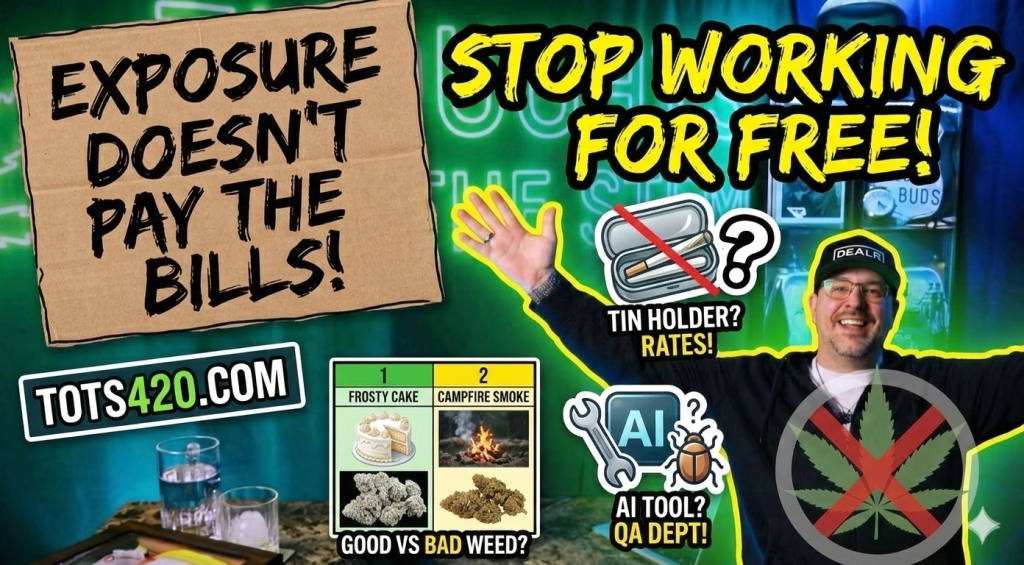
Paying with exposure is a hustle that belongs in a buddy’s garage, not a professional business.
Why Paying With Exposure Doesn’t Work in the Real World
Imagine walking into a local pot shop, asking for an ounce of top-shelf flower, and offering to settle the tab with a shout-out on your Instagram story. You’d be laughed right out of the building. Why? Because legitimate industries don’t run on “vibes” or “likes,” yet in the podcasting world, my inbox is treated like a black market dealer’s garage where everyone expects a free bag in exchange for a few errands.
Welcome to Thoughts Off The Stem. I’m Justin Barone, and I hope life is being good to you, because lately, life has been acting like a prospecting pimp and I’m his prospective hoe. Recently, a couple of companies reached out with their pimp hand asking for me to get on the track and work for nothing but a slap in the face.
Light them if you got them, ‘cause here’s how these “exposure” deals played out.
The Worst “Paying With Exposure” Brand Deals I’ve Seen
Recently, a few companies reached out with “opportunities” that were really just chores in disguise. If you’re a creator, watch out for these red flags.
1. The Tin Joint Holder Tactic
A company reached out wanting a full suite of content: social shorts, feed posts, stories, a website feature on Tots420.com, and a spot on my YouTube review playlist.
The Offer: A free sample.
The Reality: They asked for my rates, saw them, and vanished. If you want a billboard, you have to pay the lease. A $10 tin doesn’t buy a week of production time.
2. The AI Tool That Wanted a Free Employee
This one was a masterclass in audacity. An AI podcast editing tool wanted a “partnership” where I would:
Edit one episode a week for three months using their (buggy) software.
Act as their unpaid QA and R&D department (reporting bugs and UI feedback).
Give them free rights to all my content for their ads.
The Payment: Use of the software.
Pro Tip: If a company asks you to find the bugs in their product while you advertise it for them, they aren’t a partner—you’re an unpaid intern.
Weed Facts: Stop Chasing THC Percentages
Before we get deeper into the “Dude, For Real?” files, let’s clear the air on some cultivation myths. THC potency is not the ultimate qualification for good weed. High potency is a byproduct of great cultivation, but a lower percentage doesn’t mean it’s “bad.”
Beyond the Hype: Weed Facts and Quality Control
Since we’re talking about high-quality work, let’s talk about high-quality flower. THC potency isn’t everything—potency is a byproduct of great cultivation.
How to Spot “Mid” Weed vs. Top-Shelf Flower
Feature
What to Look For
Smell
Pungent, bold, and nuanced. It should make your brain say, “I want to eat this.”
Look
Vibrant colors (whites, reds, oranges) with visible, “frosted” trichomes like a cake.
Feel
Sticky and slightly spongy. Stems should snap, not bend like celery.
Structure
Sativas should be light and fluffy; Indicas should be tight and dense.
The Red Flags of “Bad” Weed:
The “Musty” Nose: If it smells like a damp basement or a pile of straw, it’s aged or compromised.
The “Brown Sugar” Look: If the trichomes are amber and the bud is dirt-brown or lime-green, it’s past its prime.
The “Brittle” Touch: If it crumbles into dust or feels “wet” and tears apart instead of breaking, the cure was botched.
Dude, For Real? The “Exposure” Hall of Fame
They say there are no dumb questions, but the “Choosing Beggars” of the world prove that wrong every day. Whether it’s HuffPo asking for free articles while being a multi-million dollar entity or the guy who thinks Garlic is a valid currency for labor—the entitlement is real.
We’ve all seen the screenshots. The mechanic who gets asked for a “quick fix” for free, or the photographer (shoutout to the legends on BoredPanda) who gets told their work is “overpriced” because “I could do that with a filter.”
The bottom line: Exposure doesn’t pay the bills. Quality—whether in your flower or your content—costs money. If you want the “frosting,” you can’t pay with “crumbs.”
What’s Your Worst “Choosing Beggar” Story?
Have you ever been offered “exposure” in exchange for your hard-earned expertise? Drop a comment below or hit me up on socials. Let’s vent.
Charlie Kirk Hypocrisy: The Contradictions You Can’t Ignore
Welcome to Thoughts Off The Stem. In this sesh, I’m digging into the Charlie Kirk debate that’s been taking over social media lately. I didn’t know much about the guy until recently, but the implications of the Charlie Kirk debate for free speech and political polarization are something we need to talk about.
Timestamp
Segment Title
Key Discussion Points
0:06
The Evolution of the Debate
Moving from sports talk (Jordan vs. LeBron) to political machinery.
1:49
Emotional Investment
Why politics and religion create deep identity-based polarization.
2:49
Free Speech vs. Tactics
Analyzing “Prove Me Wrong” culture and the risk of public speaking.
5:45
Ethics of “Clip Farming”
How rage-bait and selective editing fuel social media conflict.
15:06
The Future of Discourse
Is freedom of speech at risk? The danger of celebrating a person’s demise.
24:10
Red Bulls Strain Review
Lab stats: 26.4% THC, Terpene profile, and body-high effects.
29:46
Final Sesh Thoughts
Finding the “Middle Spot” and achieving social unity.
0:06 – The Evolution of the Charlie Kirk Debate
Welcome the thoughts off the stem.
Thank you for joining me Justin Baroni on this session.
That’s great We’re going to have a nice little session.
We’re going to have a discussion.
We’re going to talk about the Charlie Kirk situation because I didn’t know very much about this guy.
The only instance that I’d had that I I’d actively engaged in watching before the events of last week was him debating college students on the merit of Michael Jordan being the GOAT versus LeBron James being the GOAT.
0:34
All of a sudden now he’s this political dude.
Now I get he’s been doing this for a while.
I don’t know how he made the jump from discussing Michael Jordan into all of a sudden this like ginormous political machine, essentially the Michael Jordan versus LeBron, LeBron debate.
0:50
Like there’s no real right and wrong.
There’s also no real consequence to that.
Like you’ll have fans that’ll come up to you and talk shit or tell you this or that or whatever they think.
But on the political landscape, all of a sudden you have like an emotion, a real viable emotion that’s attached to potentially somebody’s life.
1:10
I’m not attached to the fact that I think Michael Jordan is the greatest basketball player of all time.
And you tell me that LeBron is.
I’m not emotionally invested or nor do I like identify my life isn’t the I don’t identify my personality as being that.
1:26
Whereas I think that with politics and religion, you have a lot of people that emotionally invest themselves and identify as being that thing.
It’s seated in a moral belief of conduct and you start applying that moral belief of conduct into whatever your political leaning is.
1:49 – From Basketball Debates to the Political Charlie Kirk Debate
And then on, once you’re invested in the politics of that, you end up turning around and trying to get your voice heard.
And as you start to find that it’s harder and harder to get your voice heard, you start to maybe spin some facts and spin some things that are more in your favor that that get attention, right.
2:12
So what I, what I mean by that, what I’m trying to say by that is that a big, a big portion of Charlie Kirk’s debates we’re fueled by the understanding that he wanted somebody to prove him wrong.
2:30
So he wanted to have an open discourse about the state of America and why the conservative side of things is a stronger belief or an, a stronger identity for the country than the liberal belief, right.
2:49 – Freedom of Speech and Tactics in the Charlie Kirk Debate
I could be wrong, but I’m pretty sure that’s it.
And then that fuels this concept that I’m standing up for freedom of speech, right?
But the undertones of your freedom of speech are based in religion where a lot of people get invested to the point where it’s black and white.
3:08
There’s no, there’s no Gray area of understanding.
There’s I believe it’s this way and This is why it should be this way.
And that’s it.
But his basis was proved me wrong and I didn’t see a lot of instances where it seemed that the people that he debated were were actually like when, when and if they proved him wrong.
3:30
It didn’t seem to resonate that that was the case.
The only, the only real videos that I saw of him, I saw of him admitting a defeat in the debate was when he was talking to a deaf gentleman about the fact about some things that he had said about deaf people.
3:51
And in that case, at the end, he, he basically said, you know what?
You’re, you’re right.
I was wrong.
I shouldn’t have done that.
But that’s about a, a personal choice of words and A and a mis education on what a certain section of society is expecting, right, In terms of in terms of being integrated into the regular function of society.
4:16
So with him, if he offended somebody, he would apologize.
I don’t think that he was a racist.
I don’t really think that he was a Nazi.
I don’t think any of that craziness.
I think that that’s a narrative that people just want to blanket to people when they say something that they don’t necessarily agree with.
4:35
I do think that he posed some things that really make him look bad, but everybody does.
If you’re in the public that often, you’re eventually going to say something that not gets taken out of context, but you’re going to say something that you believe that isn’t well received, right.
4:54
So there’s a few snippets of things that he said where you’re like, well, saying it like that, I can see why people would get this impression.
But again, he’s battling an argument that is that started off as being being bred out of like a pushy kind of accept me for me attitude.
5:15
And he was trying to bring back essentially a way to be heard or an ideology that was being squashed by the louder side of things.
So he just amplified and got louder and louder and louder to the point where I think that in his attempt at trying to debate this and change an opinion, he ended up taking on the tactics that that he complained about the other side taking.
5:45 – Ethics and Tactics Within the Charlie Kirk Debate
So for example, he there was a there was a lot of complaint about how his opposition would fear monger.
They would rage bait and they would create, they would clip farm from events and rallies that they had to show their perspective only.
6:05
But I but the problem is, is that anything that I saw with him, like I had to hunt down clips that were neutral that showed both sides of the point and then allowed both sides of the point to be heard and then showed what the actual outcome was.
6:25
And I think that he started to do what his opponents do and he started to do the same thing.
He started to upload clips that were literally designed to spark emotion to polarize people.
And he would like, I think that the setting of going to a university or college campus to bait to debate college kids is is the like definition of click far or yeah, click farming or clip farming.
6:55
Sorry.
Because as an older person that has more life experience going into an environment like that, you can 1 you put yourself in a position to control the environment.
You put yourself in a position to control the discussion and you put yourself in a position to be able to use tools like verbal traps and, and, and set up directions for the way that you want to take the discussion, right.
7:22
Because when you’re going into something like that, people aren’t necessarily prepared, at least not in the beginning.
They weren’t necessarily prepared to debate them because they hadn’t sat there thinking about it.
But that was his whole purpose for being there.
So he was already coming in with this kind of like, I’m higher, I’m more prepared than you, right?
7:41
And I don’t think that the argument that he didn’t go to college has any weight because he seemed like a relatively thoughtful and intelligent person, at least he seemed to.
He seemed to really think about and understand the concepts that he was talking about.
But he definitely did from time to time cherry pick information to get his point across because there were a few instances where fact checkers and online poll systems, they basically debunked some of the things that he said.
8:13
And within his own clips, you could see that the way that his clips were pointed were definitely to show him in the majority of the time winning the debate, which would obviously gain attention for the ’cause that he’s speaking about, which would all which would ultimately, you know, take that rhetoric and try to get the younger generation to come to his side.
8:36
Which to be honest, like that’s the goal of, of any belief system is to try and get the majority of the population and the younger generation to follow that system so that it becomes prevalent and predominant as you get older.
Right.
And then the, then the people that work in that, that, that work and function in society adopt those rules, morals and mannerisms or whatever.
8:57
And they, that becomes the normal way of life, right?
So I don’t really fault him for doing anything like that.
What I fault him for is putting himself in an environment where he’s more likely than not to be debating somebody that’s less equipped to deal with the conversation that you’re having.
9:22
You can’t have limited life experience and talk about all these political, religious and moral concepts and expect an educated, thoughtful, well understood reception to it, right?
9:43
Or take on it with somebody that’s even four years into college.
You have to get out of college and get into the real world and start operating within the real world to really understand what and how, like how things and what things work well, right?
9:59
And I’m not saying 1 ideology is better than another because there’s some things that I agreed with them on and there’s other things that I definitely didn’t agree with them on.
So I really had this conflict when I was thinking about it because like, I don’t think that when you have, when you have a scenario like this, the hate and the, and the response to the situation that happened with him was disgusting at first.
10:27 – The Consequences of Polarization in the Charlie Kirk Debate
You should never celebrate somebody’s demise based on their words.
There’s no, there’s no, there’s no room in life for having someone’s demise, like having someone’s demise be the result of you disagreeing with their opinion, right?
10:46
Like, I, I feel like we should all be able to agree on that.
So whether you agreed with the guy’s concepts, morals, ideas, ideology, whatever, there’s no reason that this should have happened.
The only reason that this happens is that you’re that potentially the person is so emotionally invested in a different way of thinking that they just can’t take it anymore and they snap.
11:07
That’s what I think.
And as far as something like this happening, I feel like anytime you’re a public speaker, if you are polarizing a whole society and and, and, and like intentionally trying to do so because I intentionally that’s what he’s doing.
11:27
He’s he’s maybe not trying to not really trying to start a fight about it, but he has to recognize at some point that what he’s doing is, and I’m not talking to Charlie Kirk, I’m talking to anybody that takes a stance on one side or the other.
That person, he or she has to understand that if they’re polarizing a large society, the level of danger attached to that and being in public and discussing your views in publics in public becomes a, a big problem, like a, a predominant issue.
12:07
It’s something that you need to be prepared for, right?
Because you, you can’t expect everybody just to be like, OK, because everybody’s not like that, Pete.
There’s all kinds of different people out there that are taking on this information.
And unfortunately, in a lot of in a lot of those environments, you’re not necessarily getting, you know, the cream of the crop of society.
12:29
You’re getting people that want to argue, that want to fight, that are emotionally invested in the fight.
So their emotion rises as their opinion rises.
As your answers come up there, there’s there’s a triggering effect that that puts you in a greater sense or a greater likelihood of danger and direct danger and ultimate imminent danger.
12:53
I think so.
I think that a part of what happened was when he first started doing his debates, he, he, he was kind of easy about it.
But I think that as he rose in the political landscape, he contributed to the potential for more and more danger because he started to adapt a lot of the tactics that he was complaining about from the other side, which ultimately, in my opinion, just fires off an emotional response, right?
13:27
And as we’ve seen time and time again, the more emotional people are and the more emotionally invested in these things people are, the more they become willing to go to extremes to define or win their point, right?
13:51
So I think it’s horrible that a person of his stature could have this happen.
I think that it’s deplorable that people would think that it’s acceptable to celebrate something like that.
I think that it’s disgusting that that people are still trading clips on, oh, he was this.
14:10
They’re still trying to prove it online.
All this is going to do ultimately is create potentially create a larger divide between the two sides.
And I think that this could really have a like a profound effect on how things happen going forward.
14:35
Like there’s a, there’s a good chance that a lot of civil unrest over time is going to come from this because people on both sides aren’t just going to go, oh, well, this happened.
I mean, maybe, maybe we’ll luck out and people will see the, the major issue with having something like this happen and the, the major concerns of, of what this, what the implications mean when something like this happens.
15:06 – Freedom of Speech and the Charlie Kirk Debate Outcome
Because it’s not just about the people involved or the, or the sides that, you know, brought us to this point.
It’s also about the understanding of free speech.
And as much as I don’t think that anybody should ever be, like I said, being in danger for giving their opinion right now in the landscape of life that is act is a is a serious concern.
15:38
Like you should be worried now that you can’t say what you think or what you want because something bad could happen to you.
And on one side, I think this makes people more willing to do certain things because they start seeing, they start seeing actions like this happen and maybe they start thinking, well, yeah, I’m going to change something too.
16:04
But then on the other side, there’s the other part of what we have to get back at these guys, which could cause more a more of an uproar and more of a more of a potentially violent engagement back and forth, right, And an escalation of violence and engagement.
16:23
So I think that really everybody should just kind of take a step back, OK, and think about what the implications of this are and forget about what side you’re on, but understand that this has a real huge, like, stamp on it.
16:44 –Is Freedom of Speech at Risk?
That is freedom of speech is at risk right now because if this is how it goes, people could clam up, stop talking, and then the then the conversation dies.
But I think that we should also highlight the fact that what led to the to these events and these kinds of things happening is the over amplifying of emotion through social media, through all, any type of media really.
17:12
Because think about it.
The thing that gets you to pay attention to something is generally some kind of adverse event.
Something bad happens, then something good happens or something good happens, then something bad.
Like there’s, there’s controversy in everything that we watch now, right?
17:27
So really the only way to get eyes on anything or or ears on anything that you want to bring to the forefront of discussion is it has to be done in a way that is almost guaranteed to cause or manipulate some kind of frustration, right.
17:47
And then the next thing you know, instead of being able to have a debate about it and actually talk civilly and go back and forth on merits and ideas and have a have an open dialogue about it.
You have this very black and white my points better than your point like forum of focus to just go back and forth, right?
18:06
And then within that, because you’re emotionally attached to these ideas, the emotion grows, grows and grows and grows until boom, it just explodes.
And I think that’s what we should be more aware about now.
18:22
I think that our awareness needs to start needs to focus on the on the concept of communication and how we communicate, what we communicate and the way that we construct our delivery of information on both sides.
18:44
Because all this is doing is creating a boiling point of violence.
And that’s it.
That’s my opinion.
That’s what I think.
I know you’re thinking like, Oh yeah, pothead could really tell me about told me, told me about Charlie Kirk.
18:59
Listen dude, we are some of the most political minded or at least aware people on the planet because a lot of stoners, potheads, weed smokers are advocates for change and they always want to find a way to make things more inclusive, more peaceful, more unified.
19:25
So when you say to when, if you have the impression that somebody that smokes pot shouldn’t have an opinion on the political landscape of today, you’re ridiculous because see, there, I just did it.
I just did the same thing.
I just kind of like rage baited you a bit.
You, you’re not ridiculous.
19:42
OK, but but have but thinking like that is is a bad way to think.
Because if you haven’t smoked weed and you don’t understand what weed does, you don’t know that weed will help you think about different angles of all the different situations that you have in life.
20:04
You’ll reflect on it if you get interested, it motivates you to read and learn about it because one thing about pot is that it will make you feel insecure about the things that you don’t know, right?
And if you try to try to start having discussions about things that you don’t know, then the weed itself is going to be like, you don’t know what you’re talking about.
20:22
Shut up.
That’s why it’s taking me like 3, three tries to do this podcast because I’m not trying to talk about Charlie Kirk, the man, because it’s unfortunate what happened to him and it’s never should have happened.
And and it’s actually no matter what his beliefs are, that should never happen to somebody.
20:39
So we can’t condemn a person.
We can’t condemn people for thinking differently than us.
We have to think, we have to allow the the concept of change to take hold in our lives.
20:57
And potheads are really good at doing that because a lot of us are not just the oh, I’m student on the coach Stoner dude that everybody thinks we are.
We’re highly motivated individuals that want to learn about life and how to make life a peaceful coexistence.
21:13
OK.
And we’re very aware what we’re watching, what we’re looking at, and we’re very good at, like I said, reflecting on the values, the morals, the conversation that happens in front of us.
21:32
Because I think that the majority of potheads or stoners don’t think I know everything about everything.
They think I want to learn more about everything.
That’s what I think gives potheads the right to be able to or stoners, whatever you prefer to be called.
21:49
Weed guy.
OK, enthusiasts.
I think that’s what gives us the right to be able to have an opinion on the discussion, because I think the discussion is not about the individuals.
I think the discussion is more about the actions of the individuals.
22:06
And the actions of the individuals are the really telling part of what the disruptor is that’s happening right now.
Does that make sense?
Because right now the disruptor is the fact that neither side can have a debate without emotionally being vested to the point where at at some point you’re going to scream and yell at the person and it’s going to result in name calling versus actually defining what any kind of statistic is or really trying to understand what it is that we’re talking about.
22:41
Sometimes we just get caught up in wanting to explain the point and wanting to be right.
And I think that on both sides, that’s what happened here.
Everyone wants to be right, but instead I think that everybody needs to take a fucking breath and take a set us, take a, take a seat for a minute and just reflect on what this really means for freedom of speech and for communication in general.
23:12 – Why the Charlie Kirk Debate Highlights Social Polarization
We can’t get to the point that we’re shooting people because they don’t believe the things that you believe.
That’s not right.
No matter who it is and what they’re saying.
If they’re not physically harming people or preventing someone else living the way of the way of life that they choose to live, then that person should be allowed to speak and, and, and say their piece without having to worry about what their fate’s going to be.
23:49
That’s my take on the Charlie Kirk thing.
I think it’s very unfortunate.
It really sucks.
And because that was going to be such a heavy episode session, so I decided that I was going to smoke a bit of an indica to keep myself calm and relaxed and try to be as thoughtful as possible.
24:09
So hopefully I was and hopefully you see what you see my point.
You can also tell me if you think I’m wrong, let me know leave a comment.
But to do to do this podcast to keep my energy level at a certain comfort, I decided I was going to smoke and did smoke.
Feature
Details
Strain Name
Red Bulls (by Ripe Flowers)
Genetics / Type
Heavy Indica
THC Potency
26.4%
Primary Terpenes
Beta-Caryophyllene, Limonene, Linalool
Flavor Profile
Earthy, Peppery, Heavy Mouth-feel
Best Used For
Post-workout, Social Anxiety, Deep Relaxation
24:30 – Sesh Review: Ripe Flowers Red Bulls Strain
That’s right, this sesh I smoked.
What’s it called?
Ripe flowers, Red Bulls.
Now, I thought this was going to be a sativa.
It’s not.
It’s an indica.
That’s why I decided to smoke it because I wanted to stay calm for this.
And so this is what it is.
24:46
It’s 1g joint or sorry, it was 1g of dried herb.
I put in a joint and it’s 25 point.
No, yeah, 2026.4% THC.
It’s got, it’s got, it doesn’t say what the percentage of terps it it, it is, but it’s top five terpenes are beta carophylline, alpha humaline, D limonene, linaluol, beta miercin.
25:19
Yeah, those are the five.
It’s good.
It’s kind of tasty.
It’s got like an earthier flavor.
It has like a hint of pepper.
It’s a good Hardy smoke.
25:35
It feels, it’s got good mouth feel.
It tastes a little more smoke like than flavorful.
So that’s why I say it tastes earthy ’cause you know how sometimes you get like an earthy smoke and it and it, it’s got like this underlying body where it feels like heavy in your mouth.
This feels heavy.
25:52
But oh, you know what it’s like.
It’s like a a light cigar where you get a little flavor.
But the no, Yeah, yeah.
About a light cigar.
The smoke’s a little heavier than a light cigar, but the flavour is like a light cigar.
That’s what I’m trying to say.
26:12
The effects are very calming.
I just feel relaxed all over.
I feel like if you did some sort of physical exercise and then came home and you just wanted to sit on the couch and zone out and watch TVI feel like I could flat back it and lay down on the couch and just zone out.
26:29
You know what I’m saying, after smoking this, it’s not really a head high.
It doesn’t really hit you in the head at all.
It’s all, it’s pretty much all body, which I think is why I was able to explain myself in this one because I, like I said, I tried this like four or five times and it didn’t work out as well as I thought it was.
26:50
It burns nice and slow.
The ash is Gray, so that’s nice.
It doesn’t really, I mean, I did cough, but it doesn’t really give you a bad cough.
It tastes like it should kind of OK.
But yeah, I would recommend it.
27:06
I’d recommend it if, because I don’t know what it cost, it was donated to the show.
So if it’s not an expensive half quarter, like if it costs you 25 to 30 bucks, then it’s a good pick.
27:24
If it costs you any more than that, I wouldn’t bother.
You could get better stuff, but for just having a laid back high, I don’t know how long it’ll last.
Hopefully a bit.
This one’s really nice.
It’d be good After workout high, after workout smoke.
Make sure that you don’t get any muscle cramps the next day.
27:44
Yeah, it’s got point O 7% CBD now about what, 3/4 of the way through this gram joint that I rolled of it and I feel like the taste is getting to me.
28:01
So I’d say if you’re going to smoke this, do like a half 1/2 gram.
You probably don’t need the whole gram.
It seems strong enough.
You feel a bit in your eyes, mostly in your eyes, your cheeks, and then your whole body’s just like, oh, I’m good, I’m just going to lay back here.
But your mind is you could be social on it.
28:20
It’s a good social relaxer.
So if you have social anxiety, this might be good for you, especially if you’re a little bit high, like tightly wound, this might bring you down a bit.
Could be good.
So I recommend it.
Yeah, that’s what I say.
I say check that out.
I say what happened to Charlie Kirk is it didn’t need to happen.
28:44
It’s very disappointing act that shows you the state of society right now.
And I think that it should be a it should be a, it should be a turning point in history to adjust how we’re doing some things because violence and and aggression are becoming too familiar.
29:13
I think we need more unity and I think that that’s what this incident should show us is that that’s what we need.
We need to unify.
We need to we got to find the common ground, the middle spot, the sweet spot, and we got to start, you know, interacting on that level because the way that we’re going right now is just dude, it’s it’s leaning to chaos.
29:46
But those are my thoughts off the stem for this week.
Hope you enjoyed the sesh.
Hope you come back next week.
Thank you for joining me, Justin Baroni, your friendly neighborhood pothead.
Yeah, come back next week on Spotify and Google.
Spotify, Google Podcasts, Apple Podcasts, iTunes, YouTube, Good pods, Pod Chaser, Pod Bean, Pandora.
30:14
Anywhere you get a podcast, really, it’s out there.
Check out tots420.com.
Oh, you know what I’m going to do so on tops420.com, I’m going to put up the I had a chat with ChatGPT about what I was trying to find out about Charlie Kirk.
30:34
So I’ll put that whole conversation up so you can read it because I think it was a fair discussion.
And I think that, well, you look at it and and you decide.
If you made it this far, let me know what you think of the episode.
And yeah, until next time, keep your lids low, baby.
The Charlie Kirk debate is about more than just one person; it’s a reflection of how we communicate as a society. While I explored the Charlie Kirk debate during this sesh, I hope we can move toward more unified, civil discourse.
ID used to identify users for 24 hours after last activity
24 hours
_gat
Used to monitor number of Google Analytics server requests when using Google Tag Manager
1 minute
_ga
ID used to identify users
2 years
_gali
Used by Google Analytics to determine which links on a page are being clicked
30 seconds
_gac_
Contains information related to marketing campaigns of the user. These are shared with Google AdWords / Google Ads when the Google Ads and Google Analytics accounts are linked together.
90 days
__utma
ID used to identify users and sessions
2 years after last activity
__utmt
Used to monitor number of Google Analytics server requests
10 minutes
__utmb
Used to distinguish new sessions and visits. This cookie is set when the GA.js javascript library is loaded and there is no existing __utmb cookie. The cookie is updated every time data is sent to the Google Analytics server.
30 minutes after last activity
__utmc
Used only with old Urchin versions of Google Analytics and not with GA.js. Was used to distinguish between new sessions and visits at the end of a session.
End of session (browser)
__utmz
Contains information about the traffic source or campaign that directed user to the website. The cookie is set when the GA.js javascript is loaded and updated when data is sent to the Google Anaytics server
6 months after last activity
__utmv
Contains custom information set by the web developer via the _setCustomVar method in Google Analytics. This cookie is updated every time new data is sent to the Google Analytics server.
2 years after last activity
__utmx
Used to determine whether a user is included in an A / B or Multivariate test.
18 months
Marketing cookies are used to follow visitors to websites. The intention is to show ads that are relevant and engaging to the individual user.
A video-sharing platform for users to upload, view, and share videos across various genres and topics.
Registers a unique ID on mobile devices to enable tracking based on geographical GPS location.
1 day
VISITOR_INFO1_LIVE
Tries to estimate the users' bandwidth on pages with integrated YouTube videos. Also used for marketing
179 days
PREF
This cookie stores your preferences and other information, in particular preferred language, how many search results you wish to be shown on your page, and whether or not you wish to have Google’s SafeSearch filter turned on.
10 years from set/ update
YSC
Registers a unique ID to keep statistics of what videos from YouTube the user has seen.
Session
DEVICE_INFO
Used to detect if the visitor has accepted the marketing category in the cookie banner. This cookie is necessary for GDPR-compliance of the website.
179 days
LOGIN_INFO
This cookie is used to play YouTube videos embedded on the website.



Leave a Reply
You must be logged in to post a comment.